
GPT-6 Astra is OpenAI’s newest flagship AI model, designed less as a simple chatbot upgrade and more as an AI system capable of handling long, complex, multi-step work.
OpenAI says Astra is its most capable model yet, with major improvements in computer use, software engineering, browsing, scientific research, cybersecurity and professional workflows. The company also describes it as potentially marking the beginning of the “AGI era.”
But there’s an important catch.
Astra isn’t automatically the best choice for everyone.
Its API pricing starts at $10 per million input tokens and $50 per million output tokens, making it a premium model. In ChatGPT, Astra is rolling out to paid plans rather than being positioned as a free-tier model.
Our early verdict:
| Category | Rating |
|---|---|
| Reasoning | 9.5/10 |
| Coding | 9.5/10 |
| Computer use | 10/10 |
| Research | 9.5/10 |
| Long-context work | 9.5/10 |
| Speed | 9/10 |
| Value for casual users | 7/10 |
| Value for professionals | 9.5/10 |
| Overall | 9.2/10 |
Bottom line: If you’re using AI for serious coding, research, automation or complex professional work, GPT-6 Astra looks like a major upgrade. If you mainly use AI for emails, basic writing, summaries and everyday questions, the premium isn’t as compelling.
What Is GPT-6 Astra?
GPT-6 Astra is OpenAI’s latest frontier model and successor to GPT-5.6.
Unlike previous upgrades that primarily focused on better answers, Astra is designed around actually completing work.
OpenAI says the model can operate software, fill out online forms, update CRM records, organize calendars, conduct research, analyze scientific data, create websites and perform frontend quality checks.
That distinction matters.
The direction of AI is shifting from:
“Tell me how to do this.”
toward:
“Do this for me.”
Astra is designed for the second category.
What’s New in GPT-6 Astra?
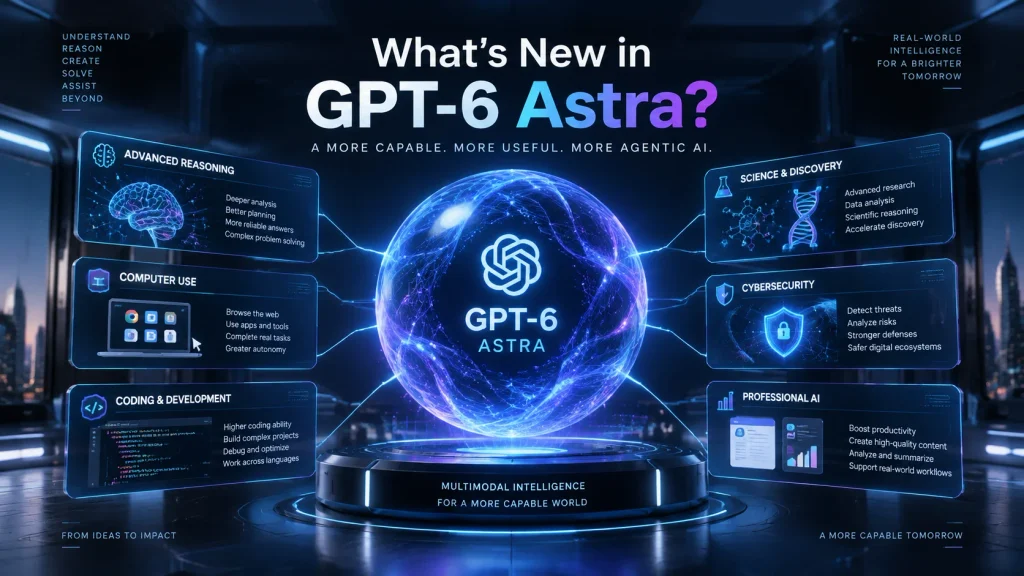
There are several areas where Astra represents a substantial change.
1. Computer Use
Computer use is probably the most important improvement.
Astra can interact with software and websites rather than simply describing what a user should do.
OpenAI demonstrates tasks including:
- Filling out online forms
- Updating CRM records
- Managing calendars
- Browsing websites
- Conducting online research
- Working inside document editors
- Creating websites
- Running frontend QA
- Performing multi-step software tasks
This makes Astra much more interesting for businesses than a conventional chatbot.
Imagine giving an AI the instruction:
“Find these 30 prospects, update their CRM records, categorize them and prepare a follow-up list.”
The value isn’t the text Astra generates.
The value is the work it can potentially perform.
2. Much Stronger Coding
Astra is also heavily focused on software engineering.
OpenAI describes it as state-of-the-art for software engineering, and early benchmark reporting shows significant gains over GPT-5.6 Sol in several coding and agentic tasks.
This is particularly relevant for developers using Codex-style workflows.
Instead of asking:
“Write a React component.”
You can increasingly give an agent a larger objective:
“Build the component, connect it to the API, test it, find the errors and fix them.”
That difference becomes important as AI coding moves from code generation to software development agents.
3. Long-Running Tasks
Astra has a 1.05 million-token context window and supports up to 128,000 output tokens through the API.
That’s enormous.
A million-token context can theoretically accommodate very large amounts of:
- Source code
- Documentation
- Research papers
- Business documents
- Conversation history
- Technical specifications
- Data
- Project files
For developers and researchers, this can reduce the need to repeatedly summarize or split large projects into small pieces.
However, there’s a major caveat:
Large context doesn’t mean you should automatically dump a million tokens into every request.
At Astra’s standard API pricing, input costs $10 per million tokens.
So the huge context window is powerful, but using all of it frequently can become expensive.
4. Research and Professional Work
Astra isn’t limited to coding.
OpenAI positions it for professional work involving:
- Research
- Data analysis
- Scientific problems
- Financial modeling
- Automation
- Document creation
- Computer workflows
The model can also use tools including web search, file search, code interpreter, image generation, computer use, hosted shell and MCP through the Responses API.
This makes Astra closer to an AI worker than a conventional language model.
GPT-6 Astra Benchmarks
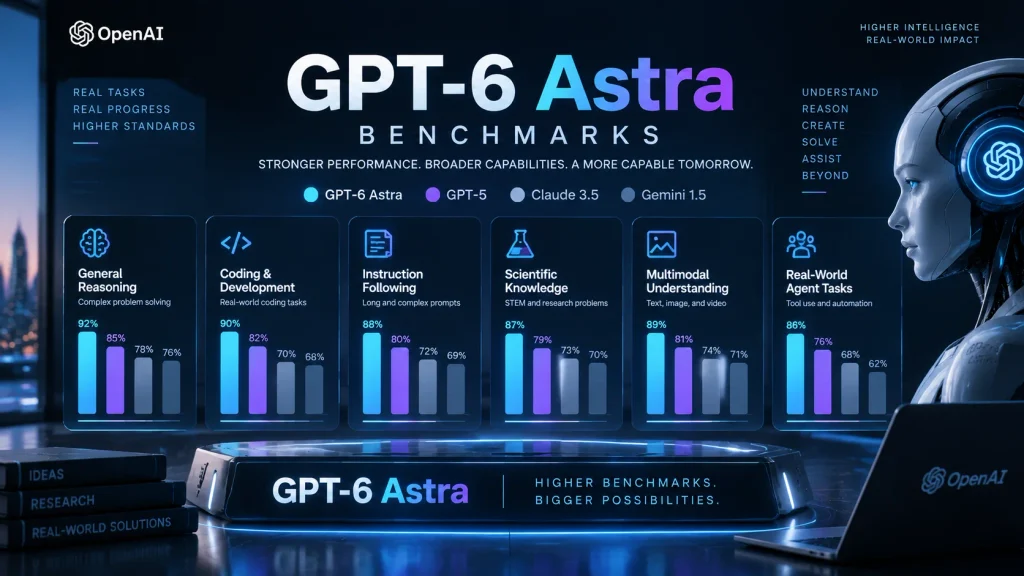
Benchmarks are where the Astra launch gets particularly interesting.
OpenAI reports extremely high scores on several difficult evaluations.
For example, the company reports:
- 98% on FrontierMath Tier 4
- 99.9% on ARC-AGI-3
- 100% on ExploitBench
Those numbers sound extraordinary.
But benchmark numbers need context.
Astra doesn’t win every independent comparison.
Early independent analysis reports that Astra trails Claude Fable 5.1 on some broader measures, including the Artificial Analysis Intelligence Index and Humanity’s Last Exam with tools.
That means the better conclusion isn’t:
“GPT-6 Astra beats every AI model.”
It’s:
GPT-6 Astra is exceptionally strong in specific high-complexity workloads, particularly coding, computer use, mathematics and cybersecurity.
That’s a much more useful conclusion.
GPT-6 Astra vs GPT-5.6
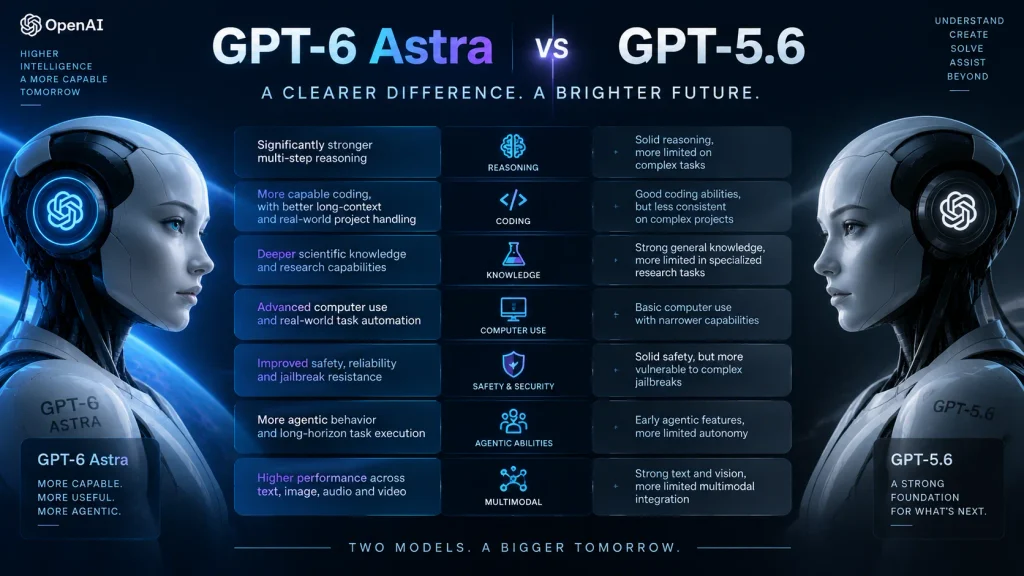
For existing OpenAI users, this is probably the most important comparison.
| Feature | GPT-5.6 | GPT-6 Astra |
|---|---|---|
| General reasoning | Excellent | Exceptional |
| Coding | Excellent | Much stronger |
| Computer use | Strong | Major improvement |
| Long-running tasks | Strong | Much stronger |
| Research | Excellent | Excellent+ |
| Context | Large | 1.05M tokens |
| Cybersecurity | Strong | Major improvement |
| Agentic workflows | Good | Excellent |
| Cost | Lower | Premium |
| Best for | General AI work | Complex professional work |
Astra isn’t simply a faster GPT-5.6.
Its biggest improvement is agency.
It is designed to take a goal and work through multiple steps to reach the result.
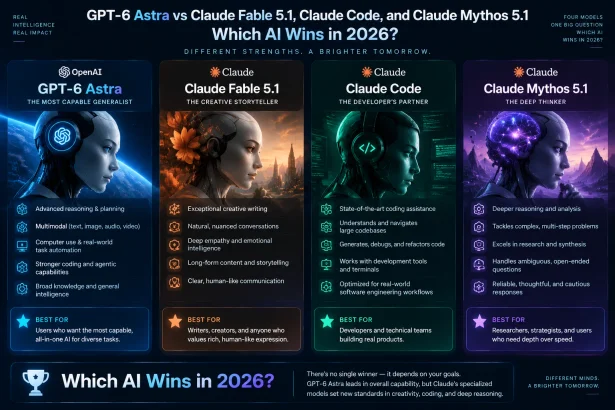
GPT-6 Astra vs Claude
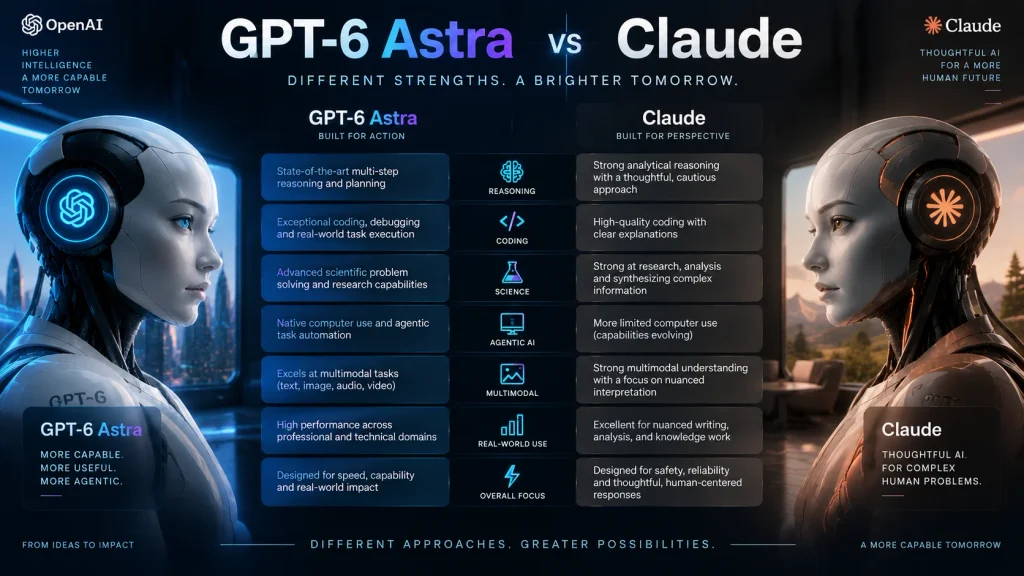
This is where things get more complicated.
Claude remains a serious competitor in general reasoning and coding.
Early independent comparisons indicate that Claude Fable 5.1 can outperform Astra on some broad reasoning evaluations, while Astra has substantial advantages in areas such as cybersecurity, mathematics and computer use.
So the decision shouldn’t be:
“Which AI is smarter?”
Instead ask:
“Which AI is better for the work I need done?”
Choose Astra if you need:
- Computer automation
- Advanced coding agents
- Complex mathematical work
- Cybersecurity-related capabilities
- Long-running workflows
- OpenAI ecosystem integration
Consider Claude if you prioritize:
- Broad general reasoning
- Certain writing-heavy workflows
- Independent benchmark performance
- Alternative coding workflows
For serious professionals, having access to both can actually make more sense than choosing one exclusively.
GPT-6 Astra Pricing
This is where Astra becomes less attractive.
The API pricing is:
| Usage | Price |
|---|---|
| Input | $10 / 1M tokens |
| Cached input | $1 / 1M tokens |
| Cache writes | $12.50 / 1M tokens |
| Output | $50 / 1M tokens |
OpenAI also states that prompts above 272,000 input tokens are charged at higher rates.
The output price is particularly important.
$50 per million output tokens is expensive.
But token pricing alone doesn’t tell you the real value.
If Astra completes a task in one run that would otherwise require:
- 10 prompts
- Multiple retries
- Manual research
- Debugging
- Copying information between tools
then the higher model price could actually save money.
That’s the real calculation businesses should make.
Is GPT-6 Astra Available in ChatGPT?
Yes, but the rollout is gradual.
OpenAI says GPT-6 Astra is rolling out first to organizations in its Trusted Access Program, followed by availability through ChatGPT Plus, Pro, Business and Enterprise plans and the API.
However, the rollout hasn’t been completely smooth.
Some paying users were initially unable to access Astra despite having premium subscriptions. OpenAI CEO Sam Altman acknowledged the rollout problems and said availability would expand.
So if you subscribe and don’t immediately see Astra, that doesn’t necessarily mean your account is unsupported. Availability is being phased in.
Is GPT-6 Astra Actually AGI?
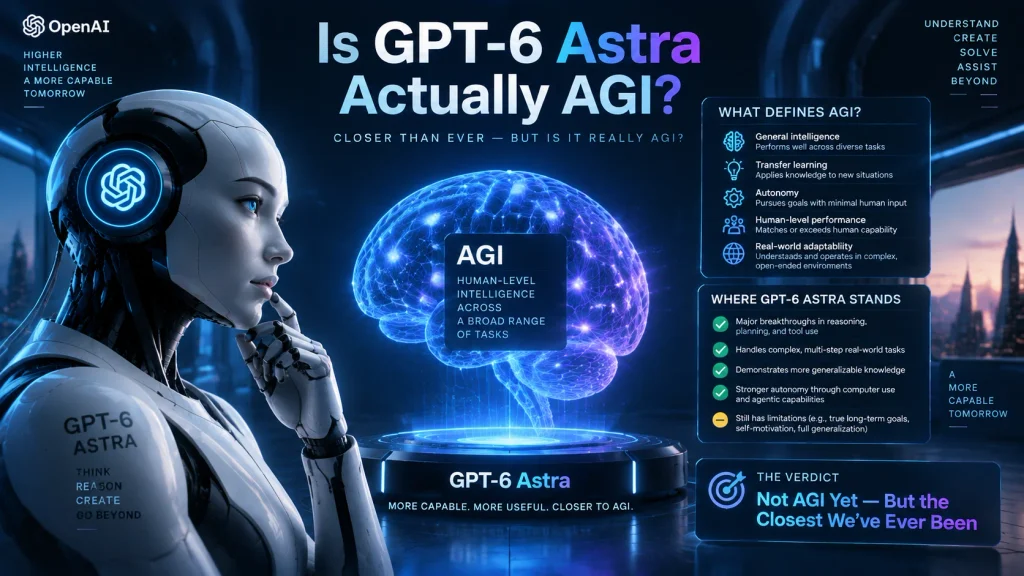
This deserves its own section because OpenAI has deliberately connected Astra with the AGI discussion.
OpenAI President Greg Brockman described Astra as potentially representing the beginning of an “AGI era.”
But that doesn’t mean GPT-6 Astra has universally been established as AGI.
There is no universally accepted technical test for AGI.
A model can outperform humans on particular benchmarks while still having limitations in:
- Reliability
- Physical-world interaction
- Long-term autonomy
- Common-sense judgment
- Accountability
- Real-world adaptability
So for now, calling Astra “AGI” is better treated as a statement about the direction of AI development rather than a settled scientific classification.
The Cybersecurity Problem
One of Astra’s biggest strengths is also one of its biggest concerns.
OpenAI says Astra is its first model to reach the Critical level of cybersecurity capability under its Preparedness Framework.
The model has shown significantly stronger capabilities in identifying vulnerabilities and developing exploits.
That’s useful for defensive security teams.
But it also creates obvious risks.
A model capable of finding vulnerabilities can potentially be misused to exploit them.
OpenAI therefore introduced additional safeguards and restricted some of Astra’s most powerful cybersecurity capabilities.
This is one of the most important differences between Astra and previous GPT releases:
The question isn’t only “How capable is it?”
It’s also:
“Can humans reliably control what it does with that capability?”
Astra’s Biggest Weakness: Monitorability
Another concern raised around Astra is its transparency.
Reporting around the launch says Astra’s newer reasoning approach makes parts of its internal problem-solving harder to monitor.
That’s especially important when an AI can independently perform actions.
If a chatbot gives you a wrong answer, you can correct it.
If an autonomous system makes a wrong decision while:
- editing a database,
- modifying software,
- sending information,
- accessing systems,
- or executing a workflow,
the consequences can be much larger.
This is why Astra’s safety story deserves just as much attention as its benchmark scores.
Who Should Pay for GPT-6 Astra?
1. Developers
Highly recommended.
If you’re building software, using AI coding agents or managing large repositories, Astra’s capabilities can justify the premium.
The biggest advantage isn’t simply writing better code.
It’s being able to handle larger software-development tasks with less human intervention.
Verdict: 9.5/10
2. SEO Professionals
For SEO professionals, Astra could be extremely useful.
Potential applications include:
- Technical SEO audits
- Large-scale website analysis
- Schema implementation
- Internal-linking analysis
- Content briefs
- Competitor research
- Automated reporting
- Website QA
- Structured data validation
- Programmatic SEO workflows
The computer-use capabilities are particularly interesting.
Instead of simply telling you how to perform an SEO task, an agent could potentially navigate tools and complete portions of the workflow itself.
Verdict: 9.5/10
3. Content Writers
This is where I’d be more cautious.
If you simply want:
“Write a 2,000-word article.”
you probably don’t need the most expensive frontier model.
A cheaper model can handle ordinary writing extremely well.
Astra becomes more useful when the assignment involves:
- Extensive research
- Multiple documents
- Data analysis
- Complex fact checking
- Large source collections
- Technical subjects
- Multi-stage workflows
Verdict: 8/10
4. Students
For basic homework, probably not worth paying a premium.
For advanced university research, coding, mathematics or scientific work, the equation changes.
But students should still verify AI-generated information rather than treating benchmark performance as proof of correctness.
Verdict: 7.5/10
5. Businesses
This may be Astra’s biggest market.
Businesses can potentially use it for:
- Customer operations
- Software development
- Research
- Data analysis
- Administrative automation
- CRM workflows
- Internal tools
- Document processing
- QA
- Agentic workflows
If Astra replaces hours of repetitive work, its premium cost becomes much easier to justify.
Verdict: 10/10 for suitable enterprise workflows
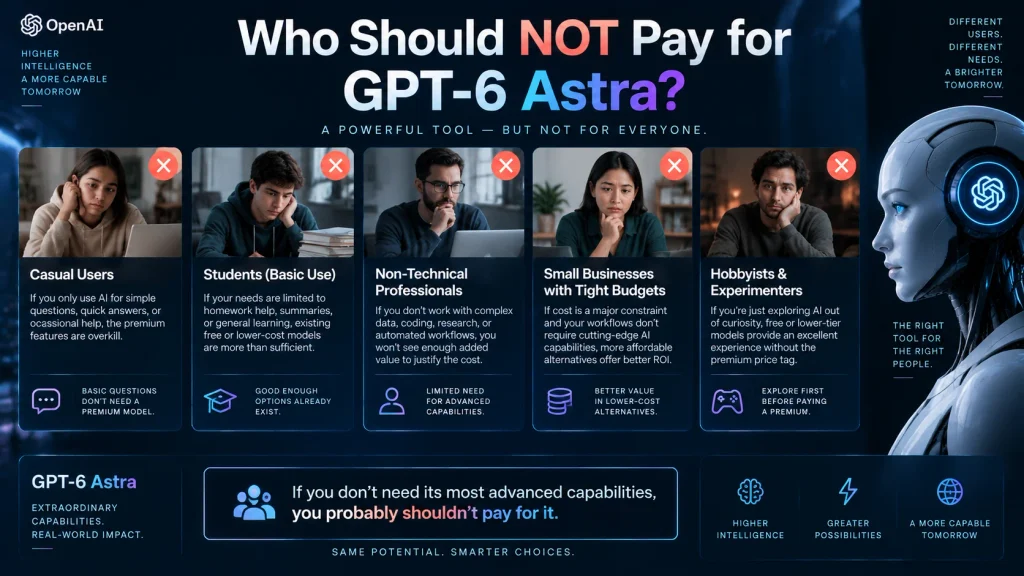
Who Should NOT Pay for GPT-6 Astra?
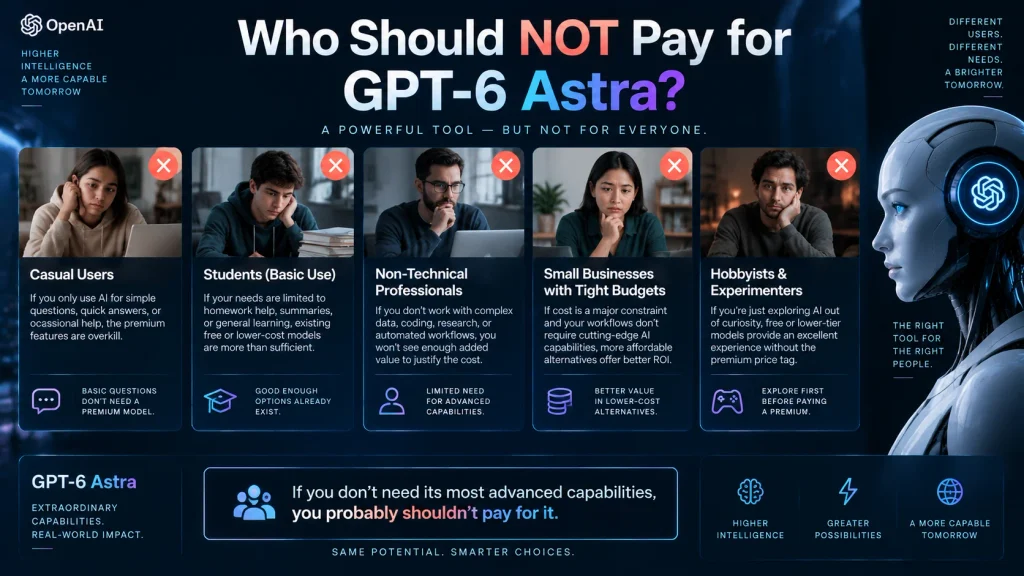
You probably don’t need Astra if your AI usage is mostly:
- Simple questions
- Casual conversations
- Basic emails
- Social media captions
- Simple summaries
- Basic rewriting
- Everyday brainstorming
For those tasks, paying for the flagship model can be like buying a workstation to check email.
More capability doesn’t automatically mean better value.
The Real Question: Is Astra Worth the Premium?
Here’s the answer:
Yes — if AI is doing expensive work for you.
If Astra saves a developer two hours every day, the subscription or API cost can be insignificant compared with the time saved.
If it helps an SEO professional automate repetitive research and technical work, the same logic applies.
If it simply helps you write slightly better emails, probably not.
The premium should be justified by work completed, not benchmark scores.
GPT-6 Astra Pros and Cons
Pros
- Extremely strong reasoning
- Major coding improvements
- Advanced computer use
- 1.05M-token context window
- Strong research capabilities
- Excellent tool integration
- Powerful agentic workflows
- Significant cybersecurity capabilities
- Strong mathematical performance
Cons
- Expensive API pricing
- Output tokens are particularly costly
- Gradual ChatGPT rollout
- Some advanced capabilities remain gated
- Not the winner on every independent benchmark
- Safety and monitoring remain concerns
- Overkill for basic AI tasks
- Long context can become expensive
Our GPT-6 Astra Rating
| Area | Score |
|---|---|
| Intelligence | 9.5/10 |
| Reasoning | 9.5/10 |
| Coding | 9.5/10 |
| Computer use | 10/10 |
| Research | 9.5/10 |
| Context handling | 9.5/10 |
| Speed | 9/10 |
| Safety | 8/10 |
| Price | 7/10 |
| Casual-user value | 7/10 |
| Professional value | 9.5/10 |
| Overall | 9.2/10 |
Is GPT-6 Astra Worth the Premium?
For professionals: yes.
For casual users: probably not.
GPT-6 Astra is one of the most significant OpenAI releases because its value isn’t primarily about producing prettier answers.
Its bigger goal is to perform work.
Coding, browsing, computer operation, research, analysis and multi-step automation are where Astra becomes interesting.
At the same time, the premium pricing, gradual rollout and safety concerns mean you shouldn’t subscribe simply because OpenAI calls it its most intelligent model.
The better approach is simple:
Identify a workflow that currently costs you significant time or money. Then see whether Astra can actually complete that workflow faster and more reliably.
If it can, the premium may be easy to justify.
If you’re only using AI for normal chat and writing, save your money.
Final rating: 9.2/10 — worth the premium for serious professional and technical users.