

Quick answer: ChatGPT can help real estate agents write property descriptions in seconds by turning basic listing details into polished, buyer-focused copy. The key is giving the tool specific inputs—square footage, standout features, neighborhood perks, and target buyer—then refining the output to match your voice and local market. Below are 25 ready-to-use prompts covering everything from luxury homes to rental units.
Writing property descriptions is one of those tasks that eats up more time than it should. You’ve walked the home, snapped the photos, and now you’re staring at a blank screen trying to make a three-bedroom ranch sound like a dream. Do it enough times and every listing starts to blur together—”cozy,” “charming,” “must-see” on repeat.
ChatGPT changes that math. Instead of drafting from scratch, you feed it the facts and let it handle the heavy lifting of phrasing, flow, and tone. A recent National Association of Realtors report found that 68% of agents who use AI tools do so specifically for marketing and content creation, and property descriptions are a big part of that. Used well, ChatGPT can shave hours off your week and help your listings actually stand out.
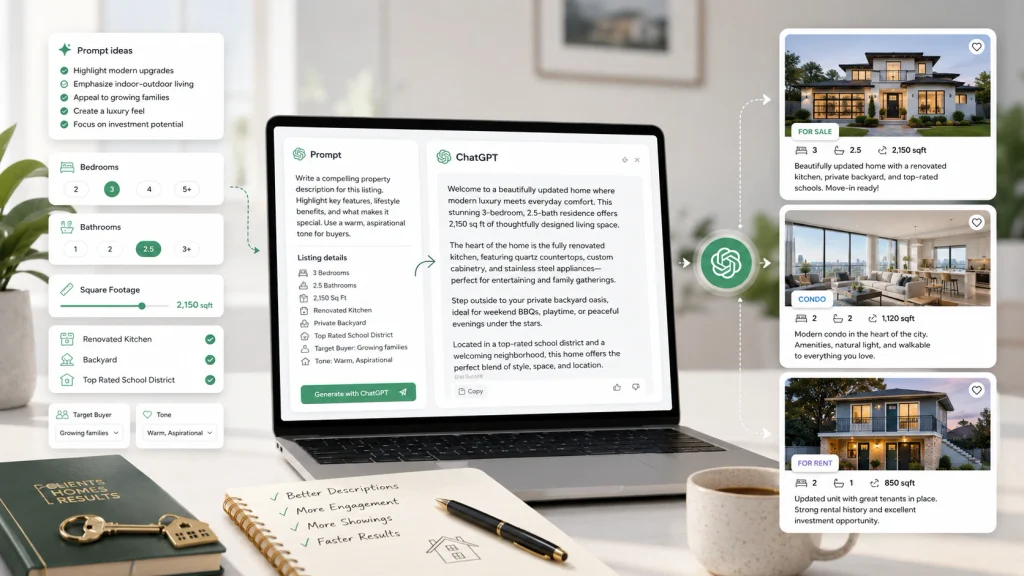
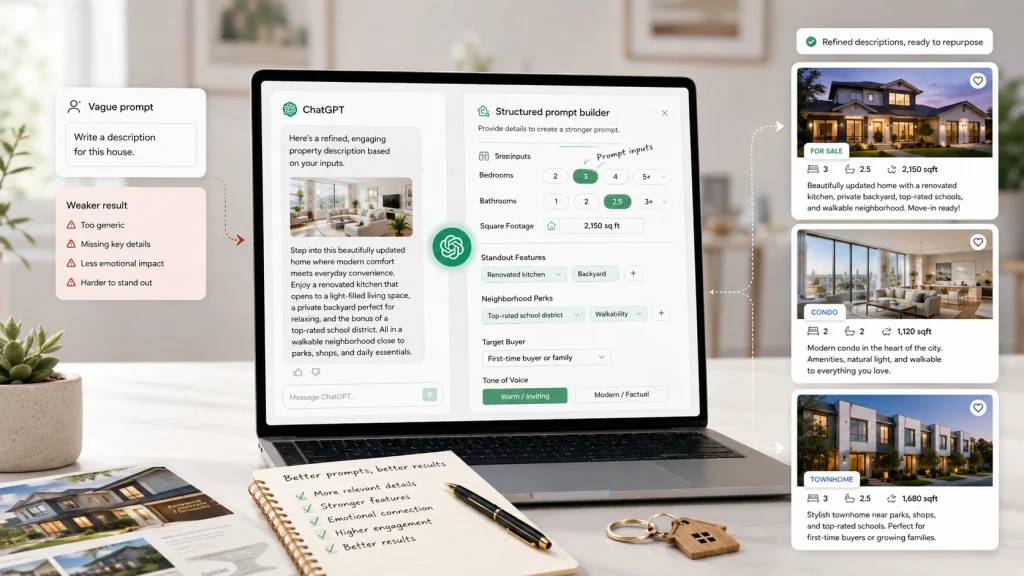
But here’s the catch: the quality of what you get out depends entirely on what you put in. Vague prompts produce vague, generic copy that sounds like every other listing online. Detailed, well-structured prompts produce descriptions that sell.
This guide gives you 25 prompts you can copy, paste, and customize right now. They’re grouped by use case—luxury listings, first-time buyers, rentals, and more—so you can jump straight to what you need. We’ll also cover a few habits that separate good AI-assisted copy from the stuff that gets ignored.
Why Use ChatGPT for Property Descriptions?
Speed is the obvious win. A description that used to take 20 minutes can take two. But the real advantage runs deeper than that.
ChatGPT is genuinely good at reframing the same information for different audiences. The same house pitched to a young family reads very differently than one pitched to a downsizing retiree or a rental investor. Swapping that angle by hand is tedious. Asking ChatGPT to “rewrite this for first-time buyers” takes seconds.
It also helps you break out of your own patterns. Every agent has a handful of go-to phrases they lean on without realizing it. ChatGPT pulls from a much wider vocabulary, which keeps your listings from sounding copy-pasted. And because it never runs out of steam at 6 p.m. on a Friday, it’s a reliable backstop when you’re staring down a stack of listings.
One important note before we dig in: ChatGPT is a starting point, not a finishing one. Fair housing laws prohibit language that could be read as discriminatory—phrases describing the ideal buyer, the surrounding demographic, or anything tied to protected classes. Always review AI output against HUD’s fair housing guidelines before publishing.
How to Write Better Prompts (Before You Copy the List)
The prompts below work far better when you feed ChatGPT real detail. A prompt that says “write a description for a house” gives you fluff. A prompt loaded with specifics gives you something usable.
Include these elements whenever you can:
- The basics: bedrooms, bathrooms, square footage, lot size, year built
- Standout features: renovated kitchen, primary suite, pool, home office, view
- Neighborhood perks: school district, walkability, nearby parks, commute times
- Target buyer: first-time buyer, family, investor, luxury purchaser
- Tone: warm and inviting, sleek and modern, straightforward and factual
Think of ChatGPT as a very fast junior copywriter. It’ll do exactly what you ask—so the more precise your ask, the better the result. For a deeper look at crafting effective inputs, our guide to writing better AI prompts breaks down the fundamentals.
25 ChatGPT Prompts for Property Descriptions
Prompts for General Listings
These are your everyday workhorses—solid starting points for most single-family homes and condos.
- “Write a 150-word property description for a [3-bedroom, 2-bath] single-family home in [neighborhood/city]. Highlight the [renovated kitchen, large backyard, and two-car garage]. Keep the tone warm and inviting.”
- “Create an MLS listing description under 100 words for a [condo] with [an open floor plan, floor-to-ceiling windows, and a private balcony]. Focus on lifestyle and natural light.”
- “Draft a property description that opens with a strong hook about [the home’s mountain views] and then covers [the layout, upgrades, and outdoor space].”
- “Write a description for a [1970s] home that leans into its [original character and charm] while noting [recent updates to the electrical and plumbing].”
- “Turn these bullet-point features into a flowing, professional description: [list your features here].”
Prompts for Luxury Properties
High-end listings call for a more refined, aspirational tone. These prompts lean into elegance without tipping into cliché.
- “Write a luxury property description for a [5,000-square-foot estate] featuring [a chef’s kitchen, wine cellar, and infinity pool]. Use sophisticated, aspirational language and keep it around 200 words.”
- “Create a description that emphasizes exclusivity and craftsmanship for a [custom-built waterfront home]. Highlight [imported materials, smart-home technology, and panoramic ocean views].”
- “Draft an elegant description for a [penthouse] that sells the lifestyle—[private elevator access, rooftop terrace, and skyline views]—more than the square footage.”
- “Write a description for a [historic mansion] that balances its heritage with modern luxury. Mention [the restored architecture alongside contemporary amenities].”
- “Describe a [luxury ski chalet] in a way that appeals to buyers looking for a second home and an experience, not just a property.”
Prompts for First-Time Buyers
First-time buyers respond to warmth, reassurance, and a sense of possibility. These prompts help you meet them there.
- “Write an approachable, encouraging description for a [starter home] aimed at first-time buyers. Emphasize [affordability, move-in-ready condition, and a friendly neighborhood].”
- “Create a description for a [townhouse] that highlights low-maintenance living and value for money, written for buyers new to the market.”
- “Draft a description that reassures nervous first-time buyers by focusing on [the home’s solid condition, updated systems, and quiet street].”
- “Write a friendly, jargon-free description for a [small bungalow] that helps a first-time buyer picture their life there.”
- “Describe a [condo near public transit] in a way that appeals to young professionals buying their first place.”
Prompts for Rentals and Investments
Rental copy has a different job—it needs to attract tenants or spotlight returns for investors.
- “Write a rental listing description for a [2-bedroom apartment] that highlights [in-unit laundry, a pet-friendly policy, and proximity to downtown]. Keep it upbeat and concise.”
- “Create a description aimed at real estate investors for a [duplex], emphasizing [rental income potential, low vacancy in the area, and recent renovations].”
- “Draft a short-term rental description for a [vacation cabin] designed to attract guests on a booking platform. Focus on the experience and amenities.”
- “Write a listing for a [studio apartment] that makes a compact space feel efficient and appealing rather than small.”
- “Describe a [multi-family property] in terms an investor cares about: cash flow, cap rate potential, and long-term value.”
Prompts for Refining and Repurposing
Sometimes you don’t need a fresh description—you need to fix or adapt one you already have.
- “Rewrite this property description to sound more [upscale/casual/family-friendly]: [paste your description].”
- “Shorten this description to fit a 100-character social media caption while keeping the strongest selling point: [paste your description].”
- “Take this description and create three versions: one for Instagram, one for an email newsletter, and one for the MLS.”
- “Review this property description and flag any language that might raise fair housing concerns: [paste your description].”
- “Rewrite this description to appeal to [a downsizing retiree] instead of [a growing family]: [paste your description].”
How to Refine ChatGPT’s Output So It Actually Sells
Getting a draft is step one. Turning it into copy that converts takes a little polish. Here’s what separates listings that perform from ones that read like everything else online.
Add your local knowledge. ChatGPT doesn’t know that the coffee shop two blocks over has a line out the door every Saturday, or that the school district just topped the county rankings. Those specific, verifiable details are what make a listing feel real. Drop them in.
Cut the filler. AI has a habit of padding sentences with words like “nestled,” “boasts,” and “showcases.” A little is fine. A lot makes your listing sound like a template. Trim anything that doesn’t earn its place.
Read it out loud. If a sentence feels clunky when you say it, it’ll feel clunky to a buyer scrolling on their phone. Reading aloud catches awkward phrasing fast.
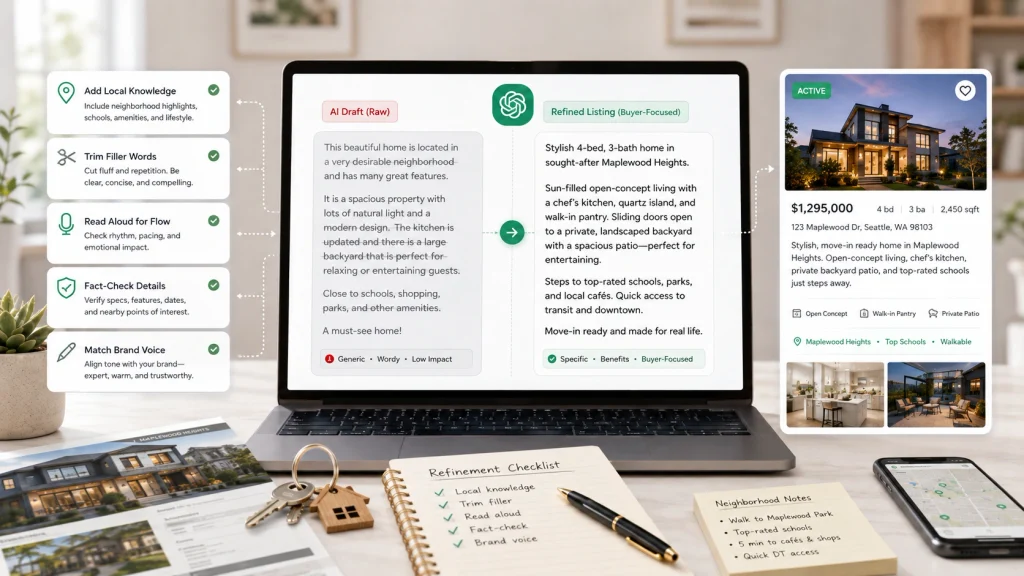
Fact-check everything. ChatGPT will occasionally invent a feature or exaggerate a detail. Never publish a description without confirming every claim matches the actual property. A description promising a two-car garage on a home with a carport isn’t just sloppy—it can land you in legal trouble.
Match your brand voice. If your listings usually read a certain way, make sure the AI output aligns. Consistency across your marketing builds recognition, and it’s worth the extra minute to bring the copy in line with your other real estate marketing content.
Start Writing Listings That Move
The agents who get the most out of ChatGPT aren’t the ones who paste in a lazy prompt and publish whatever comes back. They’re the ones who feed it real detail, review the output with a critical eye, and add the local color no AI can fake.
Pick three or four prompts from this list and try them on your current listings. Compare the drafts to what you’d normally write. You’ll likely find the AI version gets you 80% of the way there in a fraction of the time—freeing you up to focus on the parts of the job that actually need a human: showings, negotiations, and building relationships that turn into referrals.
Save this list, tweak the prompts to fit your market, and keep the ones that consistently deliver. Over time you’ll build a personal library of go-to prompts that sound like you and sell like crazy.