
GPT-6 Astra vs Claude Fable 5.1
The AI model race has become much harder to summarize than simply asking “Which model is smarter?”
OpenAI released GPT-6 Astra on September 3, 2026, while Anthropic released Claude Fable 5.1 and Claude Mythos 5.1 on September 1. Both companies are targeting difficult coding, research, professional and agentic workloads.
And there is an important distinction:
Claude Code isn’t another Claude model.
Claude Code is Anthropic’s coding agent/product that can use Claude models to work through software-development tasks.
Likewise, Claude Fable 5.1 and Claude Mythos 5.1 are the same underlying model with different safeguard configurations, according to Anthropic. Fable is generally available, while Mythos is restricted to vetted users and projects.
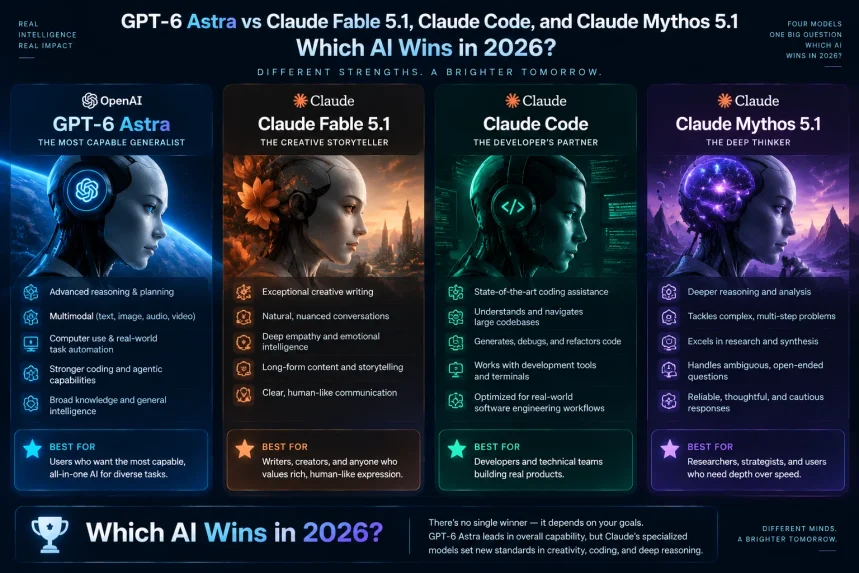
So this comparison is really about four different things:
- GPT-6 Astra — OpenAI’s flagship model
- Claude Fable 5.1 — Anthropic’s general-purpose frontier model
- Claude Code — Anthropic’s coding agent/work environment
- Claude Mythos 5.1 — Fable 5.1 with a more permissive safeguard configuration for approved high-risk research
Our early verdict
| Category | Winner |
|---|---|
| General intelligence | Claude Fable 5.1 / Astra — very close |
| Computer use | GPT-6 Astra |
| Coding model | GPT-6 Astra / Fable 5.1 — close |
| Coding workflow | Claude Code |
| Mathematical reasoning | GPT-6 Astra |
| Research | Tie / depends on workflow |
| Cybersecurity | GPT-6 Astra / Mythos 5.1 |
| Autonomous computer tasks | GPT-6 Astra |
| Developer experience | Claude Code |
| Safety-restricted research | Claude Mythos 5.1 |
| Value | Fable 5.1 |
| Overall | No universal winner |
The biggest takeaway is this:
Astra may be the stronger general-purpose agent, while Claude Code may still be the better dedicated coding environment.
GPT-6 Astra vs Claude Fable 5.1
At first glance, these are direct competitors.
Both models are designed for:
- Coding
- Research
- Complex reasoning
- Agentic workflows
- Professional knowledge work
- Long-running tasks
- Tool use
Anthropic describes Fable 5.1 and Mythos 5.1 as its most advanced models for coding and knowledge work.
OpenAI similarly positions Astra as state-of-the-art across computer use, browsing, software engineering, cybersecurity, science and professional work.
That makes this one of the closest model battles of 2026.
1. Raw Intelligence
OpenAI has made some extraordinary benchmark claims for Astra.
The company reports:
- 98% on FrontierMath Tier 4
- 99.9% on ARC-AGI-3
- 100% on ExploitBench
However, you shouldn’t interpret that as proof that Astra wins every possible task.
Independent benchmarking paints a more complicated picture.
Artificial Analysis currently reports Claude Fable 5.1 leading its Intelligence Index, while Astra makes major gains in its coding-agent evaluation.
Another benchmark comparison currently puts Fable 5.1 slightly ahead on its composite public score, but notes that the uncertainty intervals overlap.
Verdict: Too close to call
If someone tells you one model is universally smarter based on a single benchmark, they’re oversimplifying the situation.
2. Coding
This is where the comparison gets much more interesting.
Both Astra and Fable 5.1 are excellent coding models.
Anthropic specifically launched Fable 5.1 with improvements for coding and agentic workloads. Early testing has highlighted better speed and coding performance compared with the previous generation.
Astra, meanwhile, has made major improvements in software engineering and coding-agent tasks.
OpenAI reports Astra achieving state-of-the-art results across several computer-use and agentic benchmarks.
Artificial Analysis currently reports Fable 5.1 leading its Coding Agent Index, while Astra has made significant gains and can be competitive at lower estimated cost in some configurations.
Verdict: Extremely close
For raw coding ability:
GPT-6 Astra ≈ Claude Fable 5.1
But there’s another factor.
3. Claude Code Changes the Game
Comparing GPT-6 Astra directly with Claude Code isn’t completely fair because they aren’t the same type of product.
GPT-6 Astra is a model.
Claude Code is an agentic coding environment built around Claude.
That means the question becomes:
“Which is better at coding?”
versus:
“Which gives developers the better complete coding workflow?”
Those aren’t identical questions.
Claude Code can take a software-development objective and work through the repository, execute commands, inspect results and iterate.
That workflow is one reason Claude has become particularly strong among professional developers.
Research also shows that agent orchestration matters independently of the underlying model. A recent study found that grounding and software-knowledge retrieval substantially improved final task success even when using a strong coding agent.
So:
Astra may be the stronger model for some coding tasks.
Claude Code may still be the better coding product.
That’s an important distinction for developers.
GPT-6 Astra vs Claude Code
| Feature | GPT-6 Astra | Claude Code |
|---|---|---|
| What it is | AI model | Coding agent |
| Code generation | Excellent | Excellent |
| Repository work | Excellent | Excellent |
| Terminal workflows | Strong | Excellent |
| Multi-step coding | Excellent | Excellent |
| Computer interaction | Excellent | Strong |
| Developer workflow | Good | Excellent |
| Autonomous coding | Excellent | Excellent |
| Best use | Broad agentic work | Software development |
If you’re a developer who spends most of your day inside a terminal and Git repository, Claude Code remains one of the strongest choices.
If you need the same intelligence to work across websites, applications, research and other computer tasks, Astra becomes more attractive.
4. Computer Use
This may be Astra’s biggest advantage.
OpenAI built Astra specifically to operate computers.
The company says Astra reaches state-of-the-art performance in computer-use benchmarks and can handle tasks involving websites, applications and professional workflows.
That means Astra’s capability isn’t limited to:
Input → answer
It can increasingly become:
Goal → plan → interact with software → execute → verify
That’s a major shift.
For example, instead of asking:
“How do I update 100 CRM records?”
the long-term Astra workflow is closer to:
“Update these 100 CRM records according to these rules.”
That distinction is crucial for businesses.
Winner: GPT-6 Astra
5. Research
Both models are extremely capable researchers.
Astra has strong browsing, reasoning and tool-use capabilities.
Fable 5.1 is also positioned by Anthropic for coding and knowledge work.
For research, however, the model isn’t the entire product.
The quality of:
- Search
- Retrieval
- Source selection
- Citations
- Tool orchestration
- Context management
- Verification
can matter as much as raw intelligence.
So if you’re comparing ChatGPT + Astra with Claude + Fable, you’re actually comparing complete ecosystems rather than isolated models.
Winner: Tie
For a research-heavy workflow, test both against your actual sources rather than relying on benchmark rankings.
6. Mathematics and Science
This is one area where Astra has an impressive headline advantage.
OpenAI says Astra reaches 98% on FrontierMath Tier 4 and has contributed to solving long-standing open mathematical problems.
The company also positions Astra strongly for scientific work.
This makes Astra particularly interesting for:
- Advanced mathematics
- Scientific research
- Data analysis
- Engineering
- Technical modeling
Winner: GPT-6 Astra
At least based on currently available evidence.
7. Cybersecurity
Cybersecurity is another major battlefield.
OpenAI says Astra represents a significant increase in cybersecurity capability compared with GPT-5.6 Sol, including stronger vulnerability identification and exploit-development capabilities.
Astra is also the first OpenAI model to reach the Critical level of cybersecurity capability under its Preparedness Framework.
Anthropic has also positioned Mythos 5.1 for advanced research involving cybersecurity and life sciences, while Fable 5.1 can identify software vulnerabilities. More advanced cybersecurity capabilities remain restricted.
Winner: Astra for broad capability; Mythos for restricted research
But these capabilities shouldn’t be evaluated purely by offensive power.
The quality of safeguards matters just as much.
8. Claude Mythos 5.1 Is Different
This is probably the most misunderstood part of this comparison.
Mythos 5.1 isn’t simply “a smarter Fable.”
Anthropic says Fable 5.1 and Mythos 5.1 use the same underlying model, but operate with different levels of safeguards.
Fable 5.1 is generally available.
Mythos 5.1 is restricted to approved participants, particularly for sensitive areas such as:
- Cybersecurity
- Life sciences
- Advanced research
Anthropic has described Mythos as a system for vetted professionals rather than a consumer chatbot.
So you shouldn’t write:
“Mythos 5.1 is Anthropic’s consumer flagship.”
That’s inaccurate.
It’s better described as:
A restricted configuration of the same underlying model intended for high-risk research and vetted users.
9. Fable 5.1 vs Mythos 5.1
Because they share the same underlying model, the key difference is safeguards.
| Feature | Fable 5.1 | Mythos 5.1 |
|---|---|---|
| Underlying model | Same | Same |
| General availability | Yes | No |
| Coding | Excellent | Excellent |
| Research | Excellent | Excellent |
| Cybersecurity | Restricted | More advanced access |
| Life sciences | Restricted | Advanced research |
| Safeguards | Strong | Different/more specialized |
| Target user | General professionals | Vetted researchers |
This is less of a traditional “model upgrade” and more of a capability-access configuration.
10. Which Is Better for Developers?
This is where I’d split the answer.
If you’re asking about the model:
GPT-6 Astra
is arguably the more versatile choice because it combines coding with broader computer-use capabilities.
If you’re asking about the coding environment:
Claude Code
has a major advantage.
Claude Code is designed specifically around software engineering rather than being a general AI product that happens to be excellent at coding.
For a developer spending eight hours a day inside a repository, that distinction matters.
Developer verdict:
Claude Code: 9.5/10
GPT-6 Astra: 9.5/10
Different strengths, different workflows.
11. Which Is Better for SEO Professionals?
This is especially interesting for SEO.
Astra’s computer-use capabilities could make it powerful for workflows involving:
- Google Search Console
- Analytics
- CMS platforms
- Technical audits
- Spreadsheet analysis
- Competitor research
- Website QA
- Internal linking
- Schema implementation
- Content auditing
The ability to interact with software could eventually remove many manual steps from SEO workflows.
Claude Code is particularly useful for the technical side:
- JavaScript
- Python
- WordPress development
- Shopify themes
- Scripts
- Technical SEO automation
- Large-scale content processing
My pick:
Astra for end-to-end SEO operations
Claude Code for SEO development and automation
12. Which Is Better for Content Writers?
This is much closer.
Fable 5.1 has received positive early feedback for its communication and coding abilities.
Astra is also extremely capable.
But content quality isn’t just about intelligence.
For publishing, I’d care about:
- Accuracy
- Research quality
- Citations
- Originality
- Tone
- Editing
- Fact checking
- Ability to follow a detailed content brief
Winner: Depends on workflow
For research-heavy content, I’d test both.
For straightforward article writing, you probably don’t need either model’s maximum capability.
13. Cost: Which Model Gives Better Value?
This is where things get particularly interesting.
Anthropic launched Fable 5.1 with claims of up to 45% lower cost for complex agentic workloads, largely through improved caching economics.
OpenAI positions Astra as highly capable while also reporting competitive economics in certain benchmark configurations. OpenAI’s launch material reports Astra reaching a new high on one cited evaluation at approximately 31% lower estimated API cost than Fable 5.1 in that comparison.
The important word here is estimated.
Real costs depend on:
- Input tokens
- Output tokens
- Cache usage
- Reasoning effort
- Number of tool calls
- Agent retries
- Context size
- API provider
- Workflow design
So there isn’t a universal winner on price.
Value winner: Claude Fable 5.1
At least for users whose workloads benefit heavily from Anthropic’s improved agentic caching economics.
14. Benchmark Comparison
Here’s how I’d summarize the current evidence without pretending one benchmark settles the race:
| Area | GPT-6 Astra | Claude Fable 5.1 |
|---|---|---|
| General intelligence | ★★★★★ | ★★★★★ |
| Coding | ★★★★★ | ★★★★★ |
| Computer use | ★★★★★ | ★★★★☆ |
| Mathematics | ★★★★★ | ★★★★☆ |
| Research | ★★★★★ | ★★★★★ |
| Agentic tasks | ★★★★★ | ★★★★★ |
| Cybersecurity | ★★★★★ | ★★★★★ |
| Developer workflow | ★★★★☆ | ★★★★★ |
| Cost efficiency | ★★★★☆ | ★★★★★ |
| Overall | 9.5/10 | 9.5/10 |
These star ratings are editorial judgments, not benchmark scores.
That distinction is important because the available benchmarks measure different capabilities and currently don’t produce a single undisputed winner. Independent evaluations already show Fable 5.1 leading some broad intelligence and coding-agent measurements, while OpenAI reports Astra leading several specialized evaluations.
The Biggest Difference: Model vs Agent
This is the point I would emphasize most strongly in the article.
Astra and Fable are models.
Claude Code is an agentic coding product.
And that means today’s AI competition isn’t simply:
Model A vs Model B
It’s increasingly:
Model + tools + memory + retrieval + agent + interface + safety system
versus another complete stack.
That’s why a slightly weaker model can sometimes produce better real-world results when it is packaged into a better workflow.
GPT-6 Astra vs Claude Fable 5.1: Pros and Cons
GPT-6 Astra
Pros
- Exceptional reasoning
- Excellent coding
- Strong computer use
- Strong mathematics
- Advanced cybersecurity capabilities
- Broad tool use
- Strong agentic workflows
- Huge context capability
- Strong professional-work capabilities
Cons
- Premium pricing
- Rollout is still gradual
- Very powerful capabilities create safety concerns
- Not every independent benchmark places it first
- Can be overkill for basic tasks
Claude Fable 5.1
Pros
- Excellent general reasoning
- Excellent coding
- Strong agentic performance
- Strong developer reputation
- Improved cost efficiency
- Generally available
- Strong knowledge-work performance
Cons
- Computer-use capabilities aren’t as central to its positioning as Astra
- Some advanced capabilities remain restricted
- Benchmark leadership varies by task
- Claude Code and the underlying model can be confused as the same thing
What About Claude Code?
If you’re a developer, don’t ignore Claude Code just because this is a model comparison.
Claude Code’s biggest advantage is workflow.
It is designed around the actual software-development process:
Understand repository → modify files → run commands → inspect errors → iterate → test → finish
That’s fundamentally different from opening a chatbot and asking:
“Can you write this function?”
For serious developers, the agent interface can matter almost as much as the underlying model.
What About Claude Mythos 5.1?
Mythos is most relevant if you’re working in a vetted research environment.
For ordinary users, this isn’t really a purchasing decision because access is restricted.
Its importance is strategic.
It shows that frontier AI companies are increasingly creating different capability tiers for different risk levels.
A model can potentially be:
- Extremely capable
- Generally available in one configuration
- More restricted in another
depending on the risks associated with its capabilities.
Which One Should You Choose?
Choose GPT-6 Astra if:
- You want the broadest agentic capability
- You need computer-use workflows
- You work with complex technical tasks
- You need advanced mathematics
- You want AI to interact with software
- You work across coding, research and automation
Choose Claude Fable 5.1 if:
- You want an excellent general-purpose frontier model
- Coding is a major part of your work
- You care about agentic cost efficiency
- You prefer Anthropic’s ecosystem
- You want generally available access
Choose Claude Code if:
- You’re a serious developer
- You spend most of your time in repositories
- You want an AI coding agent rather than a chatbot
- Terminal-based workflows are central to your work
Choose Mythos 5.1 if:
For most readers, you can’t simply choose it.
It’s aimed at vetted users and sensitive research environments rather than normal consumer use.
Final Verdict
The old way of comparing AI models was simple:
Which model gives the smartest answer?
That doesn’t work anymore.
GPT-6 Astra and Claude Fable 5.1 are both frontier systems capable of reasoning, coding, researching and performing complex work.
But they have different strengths.
GPT-6 Astra wins on breadth.
Its computer-use capabilities, mathematics, cybersecurity and general agentic positioning make it particularly compelling for people who want AI to actually operate software and complete multi-step work.
Claude Fable 5.1 wins on efficiency and developer-focused workflows.
And when you add Claude Code, Anthropic has a particularly strong package for professional software development.
Claude Mythos 5.1 is a different category.
It’s not simply a consumer “better Claude.” It’s a restricted configuration of the same underlying model intended for high-risk research.
Final Scorecard
| Model / Product | Best For | Score |
|---|---|---|
| GPT-6 Astra | General agentic AI | 9.5/10 |
| Claude Fable 5.1 | General intelligence + knowledge work | 9.5/10 |
| Claude Code | Professional software development | 9.5/10 |
| Claude Mythos 5.1 | Vetted high-risk research | 9/10* |
*Mythos isn’t directly comparable as a consumer product because access is restricted.
Overall winner: GPT-6 Astra — by versatility, not by a knockout.
If I had to recommend one system for the widest range of professional AI work, I’d currently give Astra the edge.
If I were choosing specifically for software development, I’d seriously consider Claude Code.
And if you’re looking for the best value rather than the absolute maximum capability, Fable 5.1 deserves a very close look.
The frontier AI race isn’t over.
In fact, with Astra and Fable 5.1 arriving within days of each other, 2026 may be the year when AI competition shifts from “who has the smartest chatbot?” to “who has the most useful AI worker?”